
Introduction
The aftermarket upgrade world offers three main categories of detail parts for scale models: photo-etch (PE), resin, and 3D printed. Each material has distinct strengths, and understanding the differences will help you choose the right upgrade — or the right combination — for every build.
Photo-Etch (PE) Parts
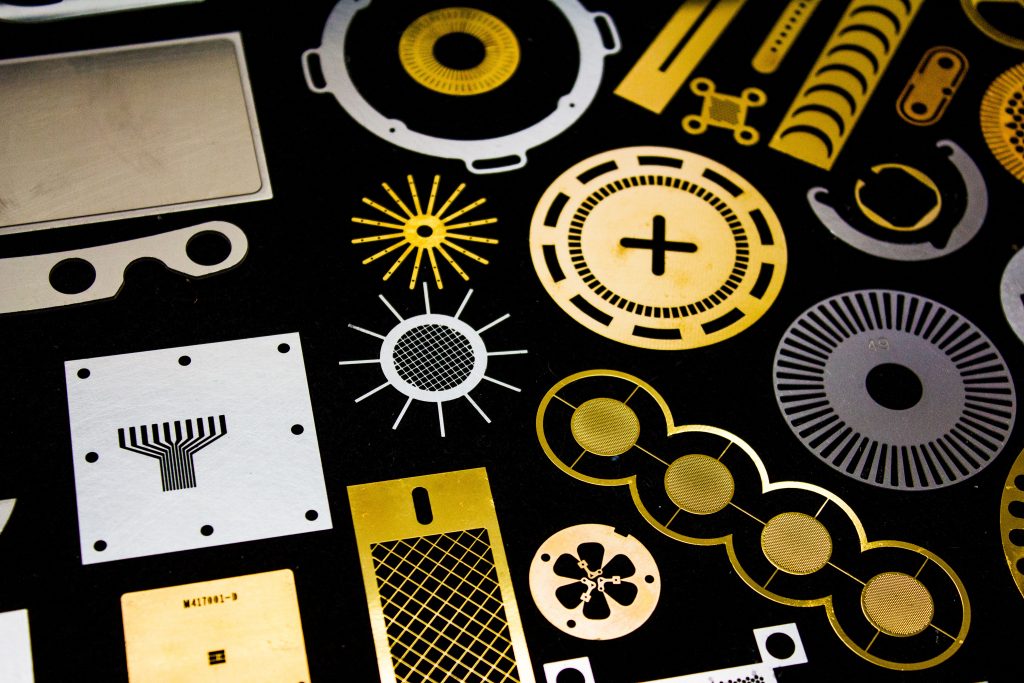
Photo-etch parts are chemically etched from thin brass sheet, typically 0.10 to 0.25 mm thick. The process produces incredibly fine flat detail — instrument panels, mesh screens, railings, seat harnesses, wing fences, and other features that need to be thin and precise. Browse all photo-etch sets.
Best for:
- Instrument panels and cockpit sidewall detail
- Ship railings, ladders, and radar arrays (ship PE sets)
- Armor engine grilles, mesh screens, and fender details
- Wing fences, airbrake interiors, and flap structures
- Seat harnesses and buckle details
Pros:
- Incredibly thin — as fine as 0.1 mm, matching real-world sheet metal at scale
- Strong brass material — withstands handling during assembly
- Precise half-etch fold lines for repeatable bends
- Huge catalog of kit-specific sets from dozens of manufacturers
Cons:
- Specialized tools required (bending tool, sharp knife, fine tweezers)
- Learning curve for bending and shaping
- Limited to shapes that can be created from flat sheet — no true 3D forms
- CA glue required (plastic cement does not bond metal)
Resin Parts
Resin aftermarket parts are cast in polyurethane using silicone molds. This process excels at producing complex three-dimensional shapes that replace entire kit parts or add components the kit omitted. Browse all resin parts.
Best for:
- Replacement wheels and tires with accurate tread patterns
- Turret interiors, engine bays, and cockpit tubs
- Figures, crew members, and diorama accessories
- Corrected hull sections, gun barrels, and exhaust nozzles
- Complete conversion sets that change the kit into a different variant
Pros:
- Complex 3D shapes with undercuts and deep detail
- Direct replacement for kit parts — often drop-in fit
- Good surface texture that accepts paint well
- Available for a wide range of subjects and scales
Cons:
- Brittle material — can chip or crack if dropped
- Requires cleanup: flash removal, pour block cutting, mold seam sanding
- Cannot match PE thinness — minimum wall thickness is around 0.5 mm
- Air bubbles possible in lower-quality castings
3D Printed Parts
3D printed aftermarket parts use high-resolution stereolithography (SLA/DLP) printers to build parts layer by layer from UV-cured resin. This is the newest technology in the aftermarket space and it is expanding rapidly. Browse 3D detail sets and 3D decals.
Best for:
- Complex organic shapes — foliage, netting, fabric folds
- Raised surface detail — rivets, panel lines, and weld beads
- 3D decals with realistic depth and texture
- Niche subjects where traditional mold tooling is not economical
- Ultra-fine lattice structures and antenna arrays
Pros:
- Unlimited geometric complexity — anything a CAD program can design
- Combines PE-level thinness with resin-style 3D form
- Rapid production — new designs can go from CAD to market in days
- No mold tooling costs, enabling small-batch and niche subjects
Cons:
- Very fragile — UV-cured resin is more brittle than cast polyurethane
- Possible layer lines on curved surfaces (varies by printer resolution)
- UV-sensitive — prolonged sunlight exposure can degrade the material
- Limited color options (most are printed in gray or translucent resin)
Head-to-Head Comparison
| Feature | Photo-Etch (PE) | Resin | 3D Printed |
|---|---|---|---|
| Material | Brass | Polyurethane resin | UV-cured resin (SLA/DLP) |
| Min. Thickness | 0.1 mm | ~0.5 mm | ~0.15 mm |
| Durability | High (metal, bendable) | Medium (brittle if thin) | Low (fragile, UV-sensitive) |
| Best Dimension | 2D (flat parts) | 3D (solid shapes) | 2.5D/3D (any geometry) |
| Adhesive | CA (super glue) | CA or epoxy | CA (thin viscosity) |
| Skill Required | Medium-High | Low-Medium | Low |
| Price Range | $5 - $30 | $8 - $40 | $3 - $25 |
Which Should You Choose?
The best upgrade depends on what you are trying to achieve:
- For flat, thin details (railings, panels, mesh, harnesses): Choose photo-etch. Nothing else matches its thinness and precision. Browse PE detail sets.
- For 3D part replacements (wheels, turret interiors, gun barrels, figures): Choose resin. It offers the best combination of shape complexity and durability. Browse resin parts.
- For surface texture and unique geometry (3D decals, netting, organic shapes): Choose 3D printed. It can produce forms impossible in either PE or traditional resin. Browse 3D detail sets and 3D decals.
The best results often come from combining all three on a single build — resin wheels, PE cockpit details, and 3D printed surface textures working together. Explore our full aftermarket catalog to find upgrades in every category.

Leave a comment
This site is protected by hCaptcha and the hCaptcha Privacy Policy and Terms of Service apply.