
In July 1806, the guns at Novo-Arkhangelsk sounded for a new ship. The fort, Juno and the American vessel Vancouver saluted as a small tender entered the water. Nikolai Rezanov gave her the name Avos. Shipwright Koriukin recorded the occasion, along with the difficulties that had come before it.
There had been sickness in the settlement. Men needed at the shipyard were repeatedly sent to work on fortifications. When Juno returned from California with provisions, construction picked up speed. Behind the salutes was the much less glamorous business of keeping people fed and getting a hull finished.
Avos is remembered alongside Juno in the title of a Russian rock opera. Follow the little tender's own course, though, and the story moves from an Alaskan shipyard to the shores of Japan. Master Korabel's 1:72 model gives that brief, eventful life a form you can build, plank by plank.

A promise in California
Juno's voyage south began with a practical need: food for the Russian settlement at Sitka. In the spring of 1806, Rezanov reached Spanish San Francisco and tried to arrange trade. There he became engaged to María de la Concepción Argüello, the 15-year-old daughter of the Presidio's commandant. A marriage would require permission across religious boundaries: he was Russian Orthodox, she was Catholic.
The wedding never happened. Rezanov left California, returned north and began the journey across Siberia. In 1807, he died in Krasnoyarsk before he could come back. His correspondence and the accounts of those who accompanied him place the engagement amid negotiations over trade and political friendship. Affection and ambition are difficult to untangle in those surviving accounts.
Concepción never married. Her life continued in California, where she devoted herself to charitable work and eventually joined the Dominican sisterhood in Benicia. She died in 1857.
In 1981, their story reached the stage in Mark Zakharov's Lenkom production of Juno and Avos, with poetry by Andrei Voznesensky and music by Alexei Rybnikov. The title brought the two ship names together, but Avos had still been on the stocks during the California voyage. Her part in the story came afterward.
Across the Pacific with Davydov and Khvostov
Avos had been built on Baranof Island at Novo-Arkhangelsk, present-day Sitka, Alaska. Her commander was Gavriil Davydov; Nikolai Khvostov commanded Juno. Their friendship predated Avos. In a letter about their first departure for America, Davydov described grasping Khvostov's hand and saying, "Now our only hope is each other" (translated from Russian).
By 1806, the two commanders were headed toward the Kuril Islands and Sakhalin, carrying instructions from Rezanov that shifted between plans and priorities. After his failed mission to establish trade with Japan, those instructions included attacks on Japanese shipping and establishments. The surviving orders reveal how uncertain the expedition's direction could be.
The little tender soon had more immediate problems. In 1806, her condition and sickness among the crew forced Davydov to make for Petropavlovsk in Kamchatka. Khvostov went on to raid Sakhalin with Juno alone. The commanders reunited afterward and prepared to sail again.
In 1807, both ships took part in attacks around Iturup in the southern Kurils and Sakhalin. Supplies were seized and people taken prisoner. The region was also home to Indigenous communities, including the Ainu, whose trade and allegiance the rival powers sought to control. The expedition's documentary history and Kiyoshi Yamaura's study place the ships within that wider confrontation.
The effects outlasted the voyage. The raids contributed to an early armed crisis in Russian–Japanese relations; its aftermath included the detention of naval officer Vasily Golovnin in 1811. Mediation secured his release and eased the crisis in 1813. Tohoku University Library describes that resolution.
Arrest, another war, and a last evening together
For Davydov and Khvostov, returning to Russia brought arrest at Okhotsk in 1807. They escaped custody and eventually went back into naval service. In 1808, they commanded gunboats in the war against Sweden and earned strong praise for their conduct. Yet the Japanese raids still followed them: Alexander I withheld their combat awards as punishment.
By 1809, Davydov had another task in hand. At Vice Admiral Shishkov's home in St. Petersburg, he was preparing a book about his earlier American voyages. Papers had been seized at Okhotsk, so he worked from surviving drafts, letters and memory. Shishkov encouraged him, and printing had already begun.
That October, the two officers spent an evening with the naturalist Georg Heinrich von Langsdorff and the American captain John DeWolf. The four had shared winters in Russian America and Kamchatka. Langsdorff recalled the pleasure of meeting again, exchanging news and revisiting their adventures. Their conversation lasted until after two in the morning.
That night, Davydov and Khvostov both drowned in the Neva near St. Isaac's bridge. Accounts differ about their final movements and the attempted crossing. The two sailors had survived the North Pacific and another war, only to die in the capital to which they had returned. Davydov's unfinished account remained with Shishkov, who described the loss in its preface.
Avos was already gone. The tender had been lost in Alaskan waters in 1808, only two years after her launch. Historical accounts disagree about the precise wreck site, as Tobin Jerel Shorey's study notes. Her brief career had linked people and places whose stories continued long after the hull was lost.
What the 1:72 model brings to the workbench
Master Korabel's Avos, kit MK0303P, brings that small Pacific vessel into a manageable display size: 420 mm long, 175 mm wide and 420 mm high. The manufacturer's specification lists laser-cut planking and parts, double hull planking, and an included 68 mm MK0103 boat kit. Master Korabel's MK0303P specification is the reference for those details.
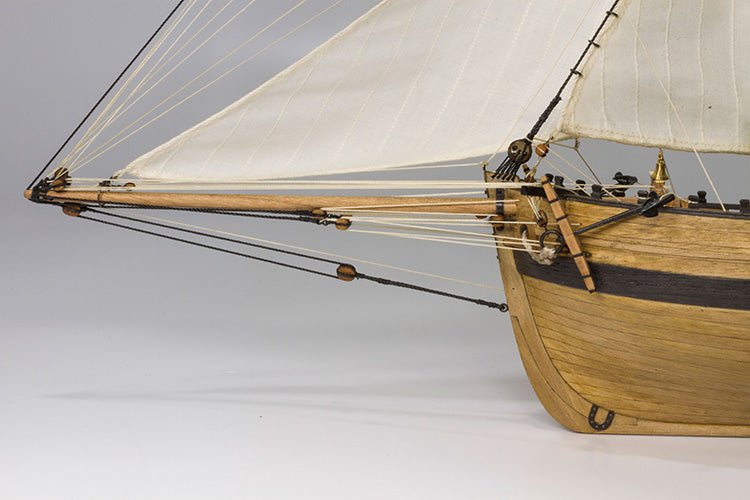
The completed-model photographs show the appeal clearly. A long bowsprit stretches ahead of the compact hull; above it, the single mast carries a web of rigging and a varied spread of sails. At deck level, fittings and the small boat reward a closer look. There is room to follow individual lines with the eye, rather than lose the vessel's shape in a forest of masts.

For a builder drawn to the less familiar ships of the age of sail, that is a strong reason to choose Avos. The finished model can prompt a conversation about Alaska, California and Japan, with a different part of the story attached to each place. It also gives the famous name a specific hull and rig.
Expect a wooden-ship project, including the sails
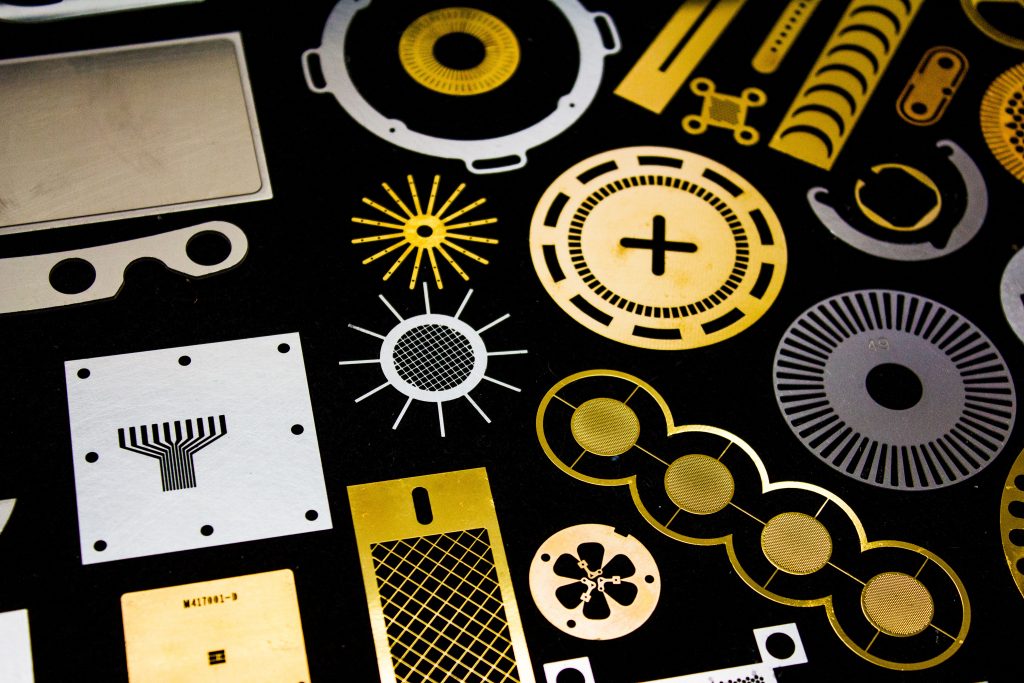
The kit's materials include a plywood structure, wood veneer, brass photo-etched fittings, wooden blocks and rigging thread. The kit supplies cotton percale cloth and patterns for making the sails; it does not include a finished sewn set. These details are documented in Master Korabel's current assembly manual, including the parts lists on pages 28–33.

Laser cutting supplies the shapes; careful fitting still matters. The instructions call for dry-fitting, beveling and sanding, as well as the later work of planking, rigging and sailmaking. Before choosing the project, look through the manual and consider which of those stages you enjoy. The modest display dimensions should not be mistaken for a promise of a quick build.
Avos offers plenty to spend time on: the run of the planking, the small fittings around the bow, the rig taking shape above the deck. Its history gives you something to think about while you work: a ship that lasted only two years, a wedding that never happened, and a travel book its author did not live to finish.
View the Master Korabel Avos 1:72 kit and check current availability at iModeller.

Laisser un commentaire
Ce site est protégé par hCaptcha, et la Politique de confidentialité et les Conditions de service de hCaptcha s’appliquent.